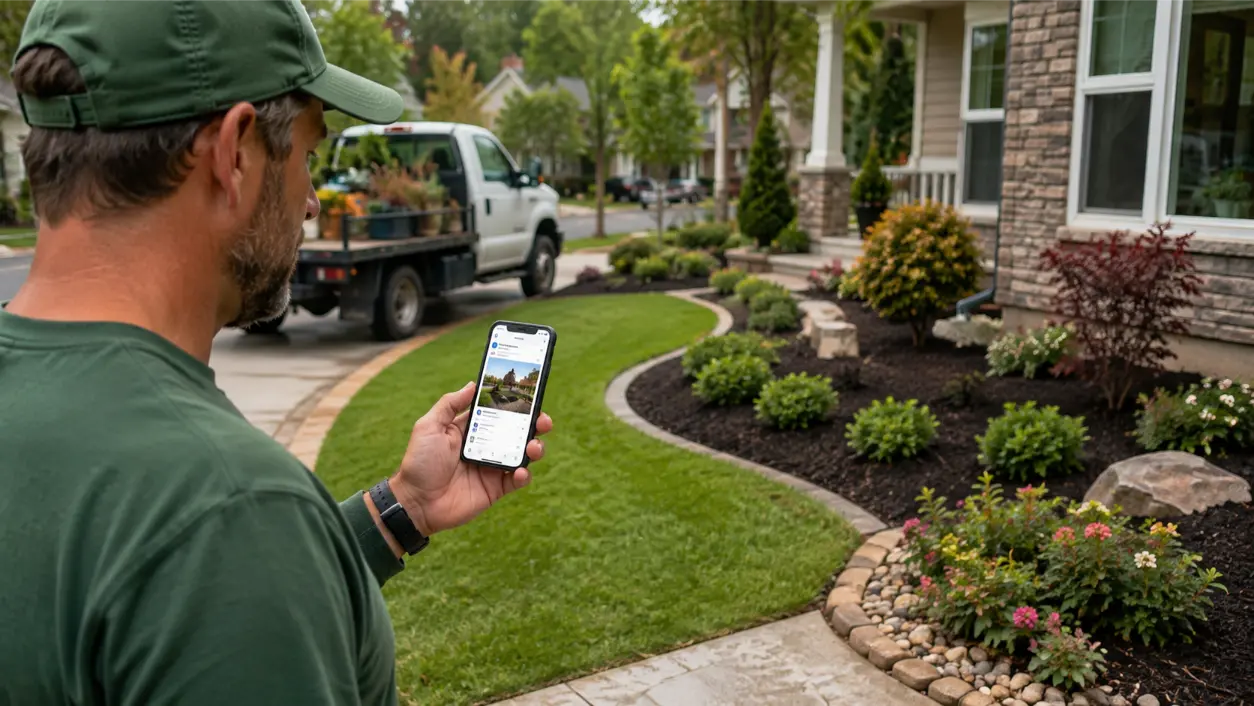
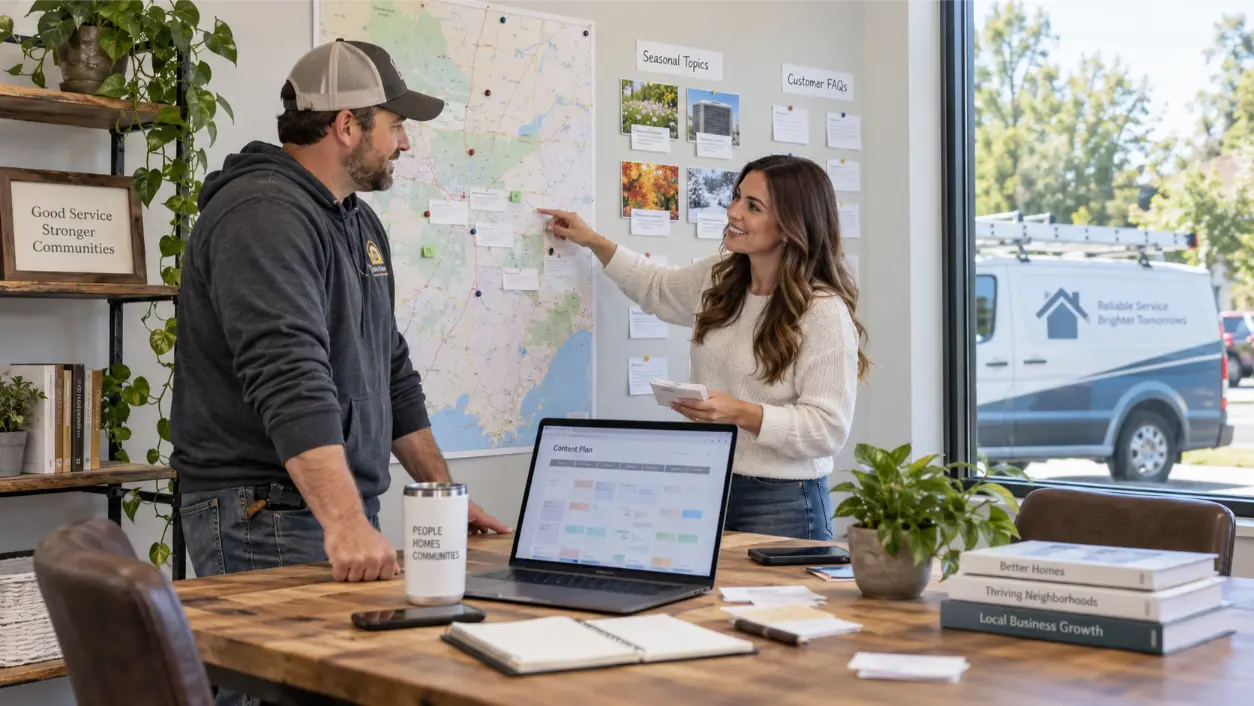
A strong local content plan for small business does not require publishing every day or creating a page for every ZIP code.
For a home service company, the simplest useful system is to organize content around three things customers already care about: where you work, what problems happen in that market, and what questions people ask before they call. Build a small set of genuinely useful service-area pages, seasonal articles, and local FAQs, then connect them to your core service pages and conversion paths. That creates a content program your team can actually maintain instead of a pile of thin pages created only to target place names.
Why Local Content Gets Complicated So Quickly
Contractors often start local SEO by creating pages for the cities they serve. The problem begins when the plan turns into many nearly identical pages with only the location name changed. Those pages are easy to produce but hard to justify and maintain.
A practical local strategy asks: what can we say about this service in this place that is genuinely helpful? Useful distinctions may involve housing patterns, weather, common service triggers, verified local requirements, or the way the business serves that area. If there is no meaningful local angle, the page may not need to exist.
Use a Four-Part Local Content System
A simple plan can be built around four recurring content types. Together they cover local relevance, buyer education, seasonality, and conversion.
1. Core Service-Area Pages
Create pages for the markets that truly matter to the business. These are not generic city introductions. A useful service-area page should explain what the company does in that area, which services are most relevant, how customers can request help, and what local context matters to the decision.
- Primary services available in the area.
- Neighborhoods or communities actually served.
- Real travel or service-area expectations when the company can state them accurately.
- Locally relevant service needs or conditions supported by real experience or authoritative sources.
- Links to the most relevant service pages.
- Clear call, form, or scheduling action.
Do not invent an office, local team, customer volume, response time, permit relationship, or neighborhood history just to make a page sound local.
2. Neighborhood or Submarket Pages Only Where They Add Value
Neighborhood pages can be useful when a contractor serves a large metro where buyer needs differ meaningfully by housing type, terrain, development age, storm exposure, utility infrastructure, or other real conditions. But they should not be an automatic second layer beneath every city page.
A roofer might explain differences between older homes and newer subdivisions; a landscaper might discuss drainage or slope; a plumber might address recurring issues tied to housing age or verified water conditions. The page earns its place when that distinction helps a homeowner make a decision.
3. Seasonal Local Topics
Home service demand changes with weather and the calendar. Seasonal content gives contractors a repeatable way to publish useful local material without inventing new topics every week.
- HVAC: first heat wave, fall furnace startup, indoor humidity, freeze preparation.
- Roofing: storm season, hail or wind inspection guidance, gutter preparation, heat-related roof concerns.
- Plumbing: freeze protection, holiday guest load, summer water use, storm-drain or sump-pump checks where relevant.
- Electrical: generator preparation, holiday lighting loads, storm outage planning, seasonal outdoor projects.
- Landscaping: spring cleanup, drainage before heavy rain, summer watering, fall pruning, winter preparation.
The strongest seasonal posts connect timing to the actual market. Avoid implying every weather event creates damage; explain what to check and when professional evaluation may be reasonable.
4. Local FAQs
FAQs are one of the easiest sources of content because the questions already exist in phone calls, estimate requests, reviews, sales conversations, and service visits. Start with the questions your team answers repeatedly.
- Do you serve my neighborhood?
- How quickly can I request an estimate or appointment?
- Do you work on older homes or newer construction?
- Which services are available in this area?
- Do local conditions affect maintenance timing?
- What should I do before a seasonal weather event?
- How do I know whether I need repair, maintenance, or replacement?
Answers should reflect the company’s actual policies and capabilities. If timing, pricing, availability, warranties, or service boundaries vary, say so.
The Simplest 90-Day Local Content Plan
A contractor does not need fifty new pages to start. A focused 90-day plan can create a useful local foundation with a manageable publishing cadence.
Month 1: Build the Foundation
- Choose the three to five service areas that matter most based on actual operations, lead quality, revenue opportunity, and existing visibility.
- Review each core service page so local pages have strong destinations to link to.
- Create or improve one high-quality service-area page per priority market.
- Document the ten most common local questions from sales, service, and customer-support conversations.
Month 2: Add Seasonal and Question-Based Content
- Publish two seasonal articles tied to current local demand.
- Publish two FAQ-driven articles based on questions customers actually ask.
- Link each article to a relevant service page and one appropriate service-area page.
- Update older pages when seasonal facts, offers, service boundaries, or contact information change.
Month 3: Expand What Works
- Review search queries, landing-page traffic, calls, forms, and booked-job data where available.
- Identify which locations and topics attract qualified engagement rather than traffic alone.
- Create one or two deeper neighborhood pages only where a meaningful local distinction exists.
- Refresh the strongest pages with better examples, FAQs, internal links, or verified local details.
After 90 days, the business should have a repeatable system rather than a one-time content burst.
How to Choose Which Cities and Neighborhoods Deserve Pages
Start with business reality, not a map. A location is a stronger candidate when the company actively serves it, wants more work there, can support the travel or service model, and has enough local context to create a distinct page.
Useful signals include existing customers, call volume, booked jobs, crew coverage, search demand, and strategic expansion plans. Avoid pages for areas the company cannot reliably serve.
Build Each Local Page Around One Clear Job
Bing’s current webmaster guidance recommends focusing each URL on a primary topic, defining entities and locations clearly, using crawlable internal links, and making important information explicit on the page. That matches a practical local SEO structure: one page should have one main job.
- A city service page should explain service availability and local relevance.
- A neighborhood page should address a real submarket distinction.
- A seasonal post should help the homeowner prepare for a timely problem.
- An FAQ article should answer one question completely.
- A core service page should explain the service itself and convert qualified demand.
Trying to make one page rank for every service, city, season, and question usually produces a vague page that is less useful to both customers and search systems.

Use Internal Links to Turn Content Into a Local System
Local content should not sit in isolation. Internal links move people from education to evaluation to action and clarify relationships among services, locations, and supporting topics.
A seasonal air-conditioning article can link to the HVAC service page and the relevant city page. A neighborhood drainage article can link to landscaping or drainage services. A local FAQ about emergency availability can link to the service page and contact path. The anchor text should describe where the link goes rather than forcing the same keyword repeatedly.
Keep Local Business Information Consistent and Verifiable
Schema.org defines LocalBusiness as a physical business or branch and provides properties for address, telephone, opening hours, and service-area information through related structured data. Structured data does not replace useful local content, but it can reinforce clear business information when the markup accurately reflects what visitors can see on the page.
Use the company’s real name, phone number, address where appropriate, hours, service areas, and contact paths consistently. Do not use structured data to claim offices, locations, reviews, services, or geographic coverage that the business does not actually have.
What to Avoid in a Neighborhood SEO Content Strategy
- Copying one city page and replacing only the place name.
- Creating pages for neighborhoods the company does not genuinely serve.
- Inventing local facts, customer stories, response times, or project examples.
- Publishing dozens of tiny FAQ pages that repeat the same answer.
- Writing generic seasonal articles with no local timing or service relevance.
- Stuffing city names into headings, footers, or paragraphs where they do not help the reader.
- Leaving local pages orphaned with no links from services, navigation, articles, or relevant hubs.
- Measuring success only by rankings instead of calls, forms, qualified leads, and booked work.
A Simple Monthly Publishing Rhythm
Once the foundation is built, many contractors can maintain the program with four monthly updates: one local-page improvement, one seasonal article, one FAQ article, and one refresh of an existing page.
Consistency and usefulness matter more than frequency. A smaller set of strong, current pages is easier to manage than a large library of thin pages.
How Core Focus Marketing Fits the Strategy
Core Focus Marketing works with home service businesses on local SEO, website performance, lead generation, call tracking, and conversion systems. Its current Home Services offering specifically emphasizes high-intent local searches, service-area targeting, SEO for core services and locations, and tracking which campaigns produce booked jobs.
If your business is competing with larger brands in local search, review Core Focus Marketing’s Home Services marketing approach, explore its Search Engine Optimization service, or schedule a consultation to build a practical local content and lead-generation plan around the markets that matter most.
FAQ: Local Content Planning for Contractors
How Many City Pages Should a Small Business Create?
There is no universal number. Start with the markets the business actually serves and prioritizes, then create pages only when there is enough distinct information to make each page useful. Three strong location pages can be more manageable than thirty near-duplicates.
Should Every Neighborhood Have Its Own SEO Page?
No. A neighborhood page is most useful when that area has a meaningful service, housing, geographic, operational, or customer distinction. If the only change is the neighborhood name, improve the broader city or service-area page instead.
What Local Blog Topics Bring Calls?
Topics closest to real service triggers tend to have the clearest business relevance: seasonal preparation, common warning signs, repair-versus-replacement questions, local weather or property conditions, and what homeowners should do before requesting service. Actual performance varies by market and service.
How Often Should a Contractor Publish Local Content?
Publish at a pace the company can maintain with accurate, useful material. A practical starting rhythm is two new articles plus one local-page improvement and one content refresh per month.
Does Local Content Guarantee Better Rankings or More Leads?
No. Local search performance depends on many factors, including competition, website quality, business information, authority, reviews, technical SEO, demand, and conversion experience. A local content plan improves the usefulness and coverage of the site but cannot guarantee rankings or lead volume.
The Bottom Line
The simplest local content plan is built around real service areas, real seasonal needs, and real customer questions. Start with a few priority markets, create useful service-area pages, publish timely local topics, answer recurring questions, and connect everything to the service pages and conversion paths that matter.
For a home service SMB, local authority grows through accumulated relevance and consistency—not by publishing hundreds of nearly identical city pages. Build a system your team can maintain, measure which locations and topics produce qualified opportunities, and expand only where the business has something genuinely useful to say.
Disclaimer: This article provides general SEO and digital marketing information and does not guarantee search rankings, traffic, leads, or revenue. Search-engine systems and local-result features change over time. Local pages, structured data, business information, and geographic claims should accurately reflect the company’s real operations and service areas.
Official Resources
RELATED LINK: Bing Webmaster Guidelines