
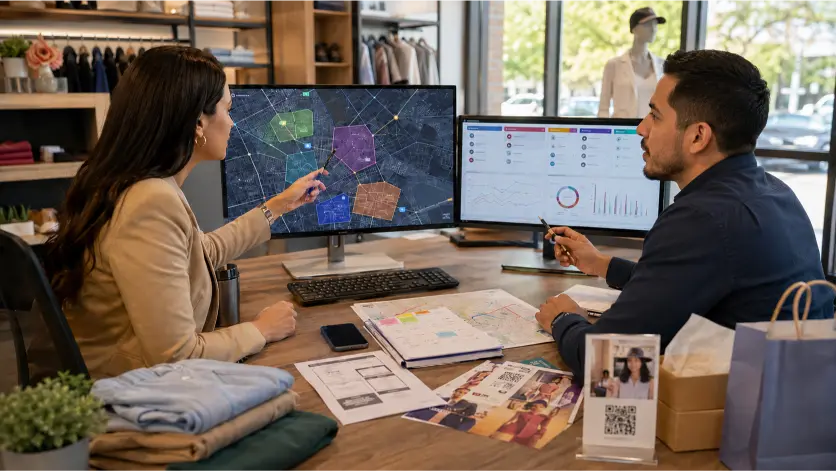
A weekend retail event has a short window to create awareness and turn that awareness into an in-person visit. Geofencing can help by placing mobile ads in front of people who enter selected real-world areas, such as nearby shopping centers, complementary businesses, commuter corridors, or competitor locations. The tactic works best when location, timing, offer, landing page, and measurement are planned as one system.
Geofencing is not a guarantee of attendance. Device signals, platform rules, audience thresholds, ad inventory, consent, and real-world behavior all affect delivery and measurement. The practical goal is to improve the odds that relevant nearby shoppers see a useful message at the moment an event is most convenient.
Here are some geofencing retail event tips.
Start With a Specific Event Outcome
Define what the campaign should produce before drawing any boundaries. For most retail events, the primary outcome is qualified store visits during a defined period. Supporting actions may include landing-page visits, coupon saves, map clicks, calls, RSVPs, or purchases tied to an event code.
Choose one primary conversion and a small set of supporting signals. A campaign becomes difficult to evaluate when awareness, app installs, online sales, calls, and in-store attendance are all treated as equal goals.
Understand What Geofencing Can and Cannot Do
A geofence is a virtual boundary around a real location. When an eligible mobile device enters that area, the device may become available for ad delivery or later retargeting, depending on the platform, permissions, and campaign configuration. This differs from broad city or ZIP-code targeting because the audience is tied to visits within a defined place.
Location data is probabilistic rather than perfect. Signals can be delayed, imprecise, unavailable, or filtered for privacy. Store-visit attribution should therefore be treated as modeled evidence rather than a literal headcount.
Choose Locations Based on Shopper Intent
The strongest geofences are not always the closest places. Build a location list around where likely attendees already spend time. Useful categories may include nearby malls, shopping districts, complementary retailers, gyms, entertainment venues, community centers, office clusters, transit hubs, and competitor stores.
Each location should have a clear reason for inclusion. A children’s apparel store might target family entertainment venues and pediatric service areas. A specialty food retailer might focus on farmers markets, culinary events, and complementary grocery destinations. Avoid adding locations simply because they are busy.
Use Competitor Geofences Carefully
Competitor-location targeting can reach shoppers already demonstrating category interest, but the message should remain professional. Focus on the event, offer, product difference, convenience, or experience rather than naming or attacking another business.
Confirm that the campaign complies with applicable platform policies, privacy obligations, and restrictions around sensitive locations. Healthcare facilities, schools, places of worship, and other sensitive venues may require special caution or may be inappropriate for targeting.
Set the Right Boundary Size
A fence that is too large can capture people who merely pass nearby. A fence that is too small may not produce enough eligible devices or ad delivery. Match the boundary to the physical footprint and movement pattern of the location.
For a mall, parking areas and entrances may matter more than the full property line. For a competitor storefront, a building-level boundary may be more useful than a broad neighborhood radius. Review maps manually and remove roads, residences, and unrelated properties when possible.

Plan the Campaign in Three Timing Phases
Before the event
Begin early enough to build awareness without exhausting frequency. The pre-event message should explain what is happening, when it occurs, where it is located, and why the shopper should care. A seven- to fourteen-day window is common for a local weekend event, but the right lead time depends on the category and travel distance.
During the event
Switch to immediate language: happening today, this weekend, while supplies last, or visit before closing. Include the address, hours, parking details, and a map-oriented call to action. Creative should be easy to understand on a phone within a few seconds.
After the event
Retarget eligible visitors and engaged users with a follow-up message. This may include a thank-you, a second-chance offer, a product reminder, loyalty enrollment, or an invitation to the next event. Keep the follow-up window limited and relevant.
Build an Offer That Is Easy to Redeem
The offer should be valuable enough to influence a visit but simple enough for staff to explain and track. Options include a limited-time discount, gift with purchase, event-only bundle, first-visitor incentive, loyalty bonus, demonstration, tasting, or appointment perk.
Publish the terms clearly. Define dates, eligible items, minimum purchase, quantity limits, and whether the offer can be combined with other promotions. Train the event team before ads begin so the in-store experience matches the promise.
Send Traffic to a Dedicated Event Page
Do not rely on an ad alone to carry every detail. The landing page should repeat the event name, date, time, address, map, offer, product highlights, parking information, and primary call to action. It should load quickly on mobile and make it easy to save directions or the offer.
Core Focus Marketing can connect location-based media with a conversion-ready website experience. Its website and landing-page capabilities help retailers give ad traffic a clear next step instead of sending visitors to a generic homepage.
Coordinate Geofencing With Social and Search
Geofencing is stronger when it supports other channels. Paid social can build visual awareness, search ads can capture people actively looking for the category or event, and retargeting can reinforce the message after a site visit or location encounter.
Retailers can review Core Focus Marketing’s social advertising and retargeting services to understand how paid social, audience follow-up, and event promotion can work alongside location-based campaigns.
Control Frequency and Creative Fatigue
A short event campaign may need enough frequency to be remembered, but repeated exposure can become wasteful. Monitor impressions per user, click-through rate, landing-page engagement, and conversion signals. Rotate creative when performance declines or when the message changes from pre-event to live-event urgency.
Use several concise variations rather than one overloaded design. One ad can lead with the offer, another with the experience, and another with the product category or convenience.
Measure Attendance With Multiple Signals
No single metric proves event success. Combine media data with business outcomes. Useful measures include geofence impressions, clicks, landing-page sessions, map interactions, calls, coupon saves, unique offer-code redemptions, point-of-sale transactions, RSVPs, and modeled store visits.
Create a baseline using normal weekend traffic and sales so the event can be compared with a typical period. Ask staff to record common customer responses and how visitors heard about the event. Directional evidence from several sources is more trustworthy than one attribution report.
Build a Practical Campaign Checklist
- Confirm the event date, hours, location, capacity, and offer.
- Choose geofence locations based on audience intent.
- Review every boundary manually and remove irrelevant areas.
- Prepare mobile creative for pre-event, live-event, and follow-up phases.
- Publish a dedicated event landing page with map and terms.
- Set frequency, budget, and conversion tracking before launch.
- Coordinate geofencing with social, search, email, and organic posts.
- Train staff on the offer and redemption process.
- Track digital signals, store visits, redemptions, and sales.
- Document lessons for the next retail event.
Common Mistakes to Avoid
- Targeting every busy location without a shopper-intent rationale.
- Using boundaries so large that commuters and residents dominate the audience.
- Launching ads without a mobile event page.
- Waiting until event day to start building awareness.
- Using an offer with unclear restrictions or difficult redemption.
- Assuming every measured visit came from the campaign.
- Ignoring platform rules, consent requirements, or sensitive-location concerns.
- Failing to coordinate the campaign with store staffing and inventory.
How Core Focus Marketing Supports Retail Event Promotion
Core Focus Marketing helps small and medium-sized businesses coordinate mobile geofencing, social advertising, search, retargeting, websites, and follow-up. Its mobile geofencing marketing service is designed to reach relevant audiences based on real-world locations and support measurable local campaigns.
A strong event campaign uses location as one targeting signal within a broader plan. The message, offer, page experience, timing, operations, and measurement still determine whether nearby attention becomes store traffic.
Frequently Asked Questions
How far in advance should geofencing ads start for a retail event?
Many local events begin awareness seven to fourteen days before the date, then increase urgency during the final days. The timing should reflect the event type, audience travel distance, and purchase decision.
Can a retailer geofence competitor stores?
Some platforms and providers support competitor-location targeting. The campaign must follow platform policies, privacy rules, and any restrictions for sensitive locations. Creative should focus on the retailer’s own offer rather than disparaging competitors.
What locations should be targeted for a grand opening?
Consider nearby shopping areas, complementary businesses, community venues, relevant events, competitor locations, and routes used by likely customers. Every location should have a clear connection to the target audience.
How can a store measure visits from geofencing?
Use modeled visit attribution together with coupon codes, map clicks, landing-page activity, point-of-sale data, RSVPs, calls, and comparisons with normal traffic. Geofencing measurement is directional, not a perfect headcount.
Does geofencing guarantee event attendance?
No. Delivery and results depend on eligible audience size, device signals, creative, offer, timing, competition, budget, landing-page quality, and the event itself.
RELATED LINK: