You’re not just competing online—you’re competing physically with whoever’s down the street pulling the same crowd. If there’s a busy competitor venue within a few blocks, you’re fighting for the same “we’re going out tonight” energy, the same parking lots, the same hotel guests, and the same last-minute decision-makers standing on a sidewalk deciding where to go.
You have to think about geofencing for event venues…
Geofencing can help you show up on the phones of people who are already in that mindset—but only if your zones, timing, and measurement are planned like an event ops timeline, not like a generic ad campaign. A fence with the wrong message, at the wrong time, measured the wrong way is just noise.
This is a practical, venue-ready playbook: what to fence, when to run, what to say, what not to do, and how to tell if it worked—without hype or sketchy tactics.
The real problem: you’re competing with a venue people can physically see
When a competitor is nearby, you’re not trying to “build awareness.” You’re trying to influence a decision that might happen in minutes:
- A couple leaves dinner and looks up “live music near me.”
- A group arrives early in the district and follows the crowd.
- A hotel guest asks the front desk what’s happening tonight.
- Someone sees a line outside the competitor and assumes it’s the place to be.
In that situation, your advantage isn’t necessarily your budget. It’s your plan: show up in the right locations, with the right message, aligned to the clock.
That’s what geofencing is good for—when you treat it like a timeline-driven attendance system, not a magic attendance button.
What geofencing can (and can’t) do for venues
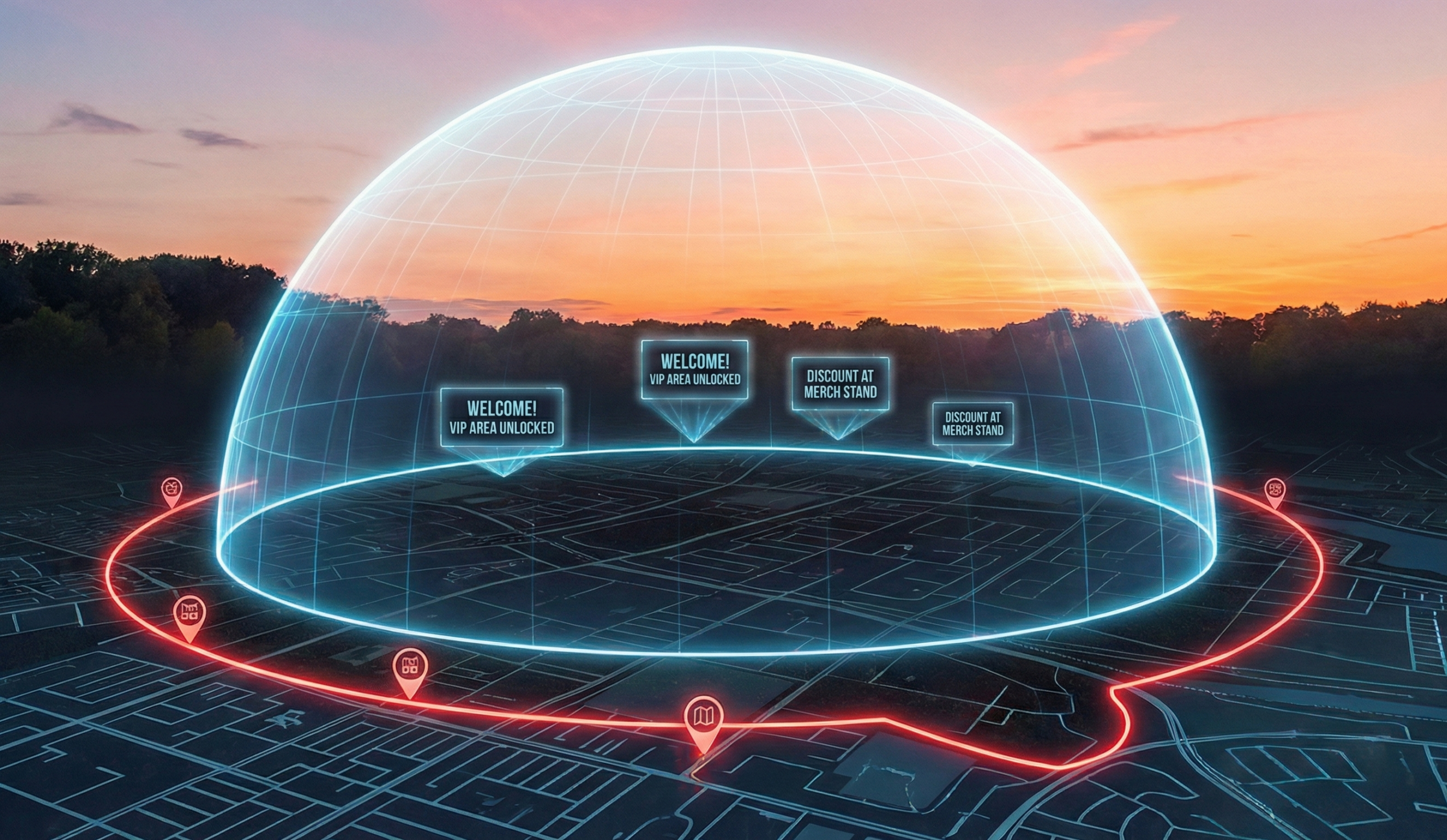
Geofencing is a location-based marketing tactic that creates a virtual boundary (a “geofence”) around a real-world area. When a device enters or exits that boundary, it can trigger an advertising action—like serving mobile ads to devices observed in that zone. Common location signals can include GPS, Wi-Fi, and cellular data. (TechTarget)
What it can do well for venues:
- Reach people who are already near your venue district, competitor, hotels, parking, or other “intent” areas.
- Support a tight event timeline (pre-event ramp, day-of capture, post-event follow-up).
- Reinforce a clear offer when the audience is close to deciding.
What it can’t do (and what you shouldn’t pretend it does):
- It can’t guarantee attendance or ticket sales.
- It can’t perfectly “track people” or prove causation by itself—measurement is modeled, and accuracy varies by environment and device permissions.
- It shouldn’t be framed as identifying specific individuals; the goal is reaching audiences in specific places, not “we know you were at X.”
If you keep those boundaries clear, geofencing becomes a practical tool in your event marketing stack—especially when the competitor is nearby and foot traffic is already concentrated.
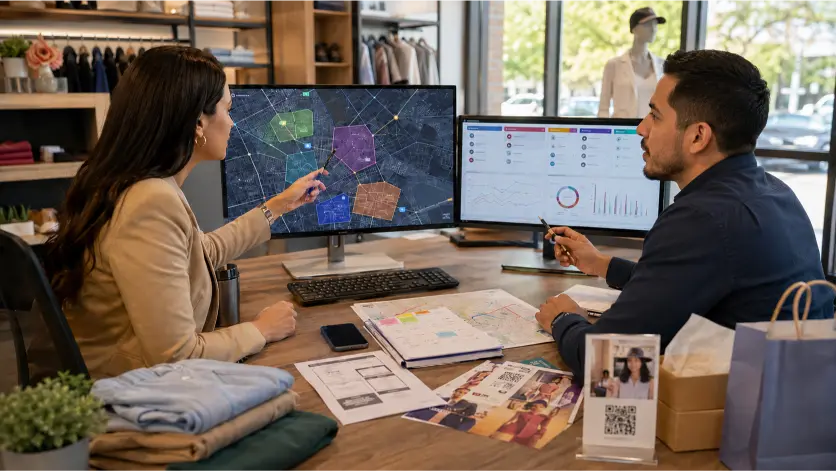
Step 1 — Pick your “zones that matter” (not just a radius)
When venues try geofencing for the first time, they often start with a broad circle around their building and call it done. That’s rarely the best place to start—because the real question is: Where are the people who are most likely to come tonight?
Think in zones that represent behavior, not geography.
Competitor venue zone (the “already-going-out” crowd)
If your event is near a busy competitor venue, this zone is the most emotionally tempting—and the most important to handle responsibly.
The strategic idea is simple: people physically near a competitor venue are often already in “show/nightlife/event” mode. Reaching them with the right message can put you in the consideration set.
The execution needs restraint:
- Don’t write ads that imply you know where someone is or where they’ve been.
- Don’t reference the competitor by name in a way that invites legal or brand issues.
- Don’t run messaging that feels invasive (“We saw you at…”).
Instead, your creative should read like helpful proximity marketing:
- “Heading out tonight? Doors at 7. Easy parking. Tickets still available.”
- “Live set starts at 8:30. Walkable from the district.”
- “VIP upgrades available at the door (limited).”
And because location data is a heightened privacy concern in the U.S., you should treat any targeting strategy around sensitive places as high-risk and avoid it entirely (more on that later). The FTC has pursued actions involving the sale and use of sensitive location data tied to visits to health-related locations and places of worship—an important reminder that “location” is not a casual dataset. (Federal Trade Commission)
Feeder zones: hotels, parking, restaurants/bars, transit approaches
This is where venues often get a cleaner win.
Feeder zones are places where people are nearby and plausibly deciding what to do next:
- Hotels within a reasonable distance (especially those with event-friendly guest profiles)
- Parking garages and lots that serve the district
- Restaurant and bar corridors where people pre-game
- Transit stops or rideshare pickup areas
You don’t need huge coverage. You need relevance.
Messaging should match the moment:
- At hotels: “Tonight in [district]: live show + late bar. 10 min away.”
- At restaurants: “After dinner plan? Doors open at 7. Walk-ins welcome if available.”
- At parking: “Park once, make the night: show at 8:30. Quick entry line.”
If you can only pick one feeder zone to start, pick the one that’s most consistently tied to your audience behavior (not the one that “sounds coolest”). If you don’t know, mark it as a test: one zone this week, another next week.
On-site zone for your venue (arrival reminders, upgrades)
Your on-site fence isn’t about “awareness.” It’s about reducing friction once someone is already there—or almost there.
Use it for:
- Arrival logistics (parking reminders, entry door, start time)
- Low-stress upgrades (VIP, reserved seating, drink package—if you offer those)
- Last-minute conversions (if you support at-the-door purchase or quick online checkout)
The key: don’t treat people who arrive as a generic audience. Treat them like guests who want clarity and speed.
Step 2 — Build a simple event timeline: pre-event, day-of, post-event
Geofencing works best when your campaign flow mirrors how events actually happen. A useful structure is:
- T-14 to T-3: build intent and credibility
- T-2 to day-of: capture and convert
- T+1 to T+14: convert momentum into repeat attendance and inquiries
You don’t need a complicated media calendar. You need a message ladder that makes sense.
Pre-event (create intent): lineup/experience, social proof, urgency without discount addiction
Two weeks out, you’re selling the reason someone should choose you over the competitor. You’re not selling logistics yet.
Good pre-event creative themes:
- The experience: who’s performing, what makes it unique, what the night feels like
- Credibility: recognizable acts, past crowd energy, venue vibe (without faking “sold out” pressure)
- Clear CTA: “Get tickets,” “Reserve,” “Join the list,” depending on your model
Avoid the trap of training your market to wait for discounts. If your only lever is “2-for-1,” you may fill seats sometimes, but you also teach people that urgency is negotiable.
Instead, use non-discount urgency:
- “Limited capacity”
- “VIP/Reserved sections limited”
- “Early arrival recommended”
And be honest. Manufactured scarcity erodes trust fast in local markets.
Day-of (capture intent): “doors open,” parking, last-minute inventory, VIP upgrades
Day-of is when proximity matters most. People are already in motion. Your job is to remove uncertainty and give them a confident next step.
Day-of message priorities:
- Doors time + start time
- Parking and entry clarity
- “Still available” or “Limited availability” (only if true)
- Walk-up options (if you support them)
If a competitor venue is nearby, your day-of messaging should emphasize ease:
- “Quick entry”
- “Easy parking”
- “Walkable from the district”
- “Short set times” (if relevant)
- “Late-night option” (if your schedule supports it)
A good day-of ad doesn’t feel like persuasion. It feels like a helpful sign.
Post-event (convert momentum): newsletter signups, next show, private event inquiries
Post-event is where many venues waste the biggest opportunity. You paid to reach people at the moment they cared—now keep the relationship without being annoying.
Post-event goals:
- Build an owned audience (email/SMS list) so you’re less dependent on paid media next time
- Promote the next relevant event
- Drive venue inquiries (private events, rentals, corporate bookings)
Post-event creative should feel like continuity:
- “Thanks for a great night—here’s what’s next.”
- “Want early access to upcoming shows?”
- “Planning a party? Here’s our venue options.”
This is also where retargeting (beyond geofencing) can work well—especially if you’re already running display retargeting or social retargeting.
The contrarian moment: “Geofencing isn’t the strategy—your offer sequencing is.”
It’s easy to obsess over fence shapes and radiuses because they feel technical—and controllable.
But here’s what actually makes or breaks venue geofencing:
If your message ladder doesn’t match the moment, the fence won’t save you.
A simple sequencing model for venues:
- Awareness: “This event exists and it’s worth your night.”
- Intent: “Here’s why you’ll like it (vibe, artist, theme, experience).”
- Action: “Here’s exactly what to do now (tickets, doors, parking, entry).”
Most failed campaigns skip straight to “Buy tickets” without earning intent—or they run “doors open” creative two weeks early when it’s irrelevant.
When you’re near a competitor venue, sequencing matters even more:
- Pre-event: make the case you’re the better choice for a certain type of night
- Day-of: remove friction and make choosing you feel easy
- Post-event: build retention so the next event is easier to fill
Your strategy is the story you tell over time. Geofencing just helps deliver it in the right places.
Common geofencing failure modes for venues (and how to avoid them)
Failure mode 1: The fence is too big, so the audience is too mixed
If you fence “the whole city,” you’ll reach plenty of people—but not necessarily people who are about to attend tonight.
Fix: start smaller and more behavior-driven (competitor zone, feeder zones, your venue). Earn the right to expand.
Failure mode 2: The creative is generic, so it becomes invisible
“Live music tonight” is not an offer. It’s wallpaper.
Fix: make one clear promise:
- A specific act or theme
- A clear start time
- A real reason to choose you (vibe, genre, experience)
- A simple action step
Failure mode 3: The landing experience doesn’t match the ad
If the ad says “Doors at 7” but the landing page hides details, you lose momentum.
If the ad says “Tickets available” but checkout is slow, you lose the decision window.
Fix: create a dedicated event page (or at least a clean section) with:
- Date/time
- Location + parking note
- Ticket link / reservation flow
- Simple FAQs (age policy, start times, seating)
Failure mode 4: You measure the wrong thing
If you only measure impressions and clicks, you’re measuring activity—not attendance.
Fix: decide your primary success metric in advance:
- Ticket purchases (if trackable)
- RSVP starts/completions
- Calls and inquiries
- On-site scans/check-ins (if your system allows it)
Then treat everything else as supporting signals.
Failure mode 5: You ignore iOS permission reality and overpromise precision
A big part of modern ad measurement depends on what devices and users permit. Apple’s App Tracking Transparency requires apps to request permission to track activity across other companies’ apps and websites, and users can choose “Ask App Not to Track.” (Soporte de Apple)
Fix: plan measurement as “directional, not perfect,” and use multiple signals (tickets + inquiries + trend comparisons). Don’t build your campaign narrative on false precision.
Measurement that a venue can actually use (without pretending it’s perfect)
The honest truth: most location-driven measurement is not a courtroom-proof record. It’s a model designed to help you make better decisions.
Foot traffic attribution, for example, is commonly described as connecting digital ad exposure to real-world visits—useful, but dependent on methodology and definitions. (madhive.com)
So what should a venue do?
What to track: build a simple scoreboard
Start with the metrics you can actually act on:
- Ticket clicks and purchases (if you have a reliable tracking setup)
- RSVP starts/completions
- Calls and form inquiries (especially for private events)
- On-site check-ins/scans (if your ticketing system supports it)
- Email/SMS signups after the event
If your current tools don’t support some of these, mark it as TBD and focus on what you can measure now.
Understand “store visit / foot traffic style” attribution as a modeled estimate
Some platforms estimate physical visits using aggregated, opted-in signals. Google Ads “store visit conversions,” for example, describes scenarios involving users signed in to Google and opted into Location History. (Asistencia de Google)
The practical takeaway for venues:
- Treat visit/foot-traffic metrics as directional support, not the headline proof.
- Always ask: “How does this provider define a visit? What signals are required? What’s excluded?”
- Prefer trends over single numbers.
“Sanity checks” that make your results more believable
If you want to know whether geofencing likely helped, use sanity checks that don’t require perfect tracking:
- Compare against a baseline
Look at similar event nights (same day of week, comparable lineup, comparable season) and compare:
- Ticket pace (T-14, T-7, day-of)
- Inquiry volume
- Walk-up volume (if applicable)
- Use geographic comparisons
If you fenced competitor + feeder zones, compare response rates by zone. Even if it’s not perfect, patterns can tell you where intent lives. - Run controlled variation
If you can, vary one thing at a time:
- Same fence, different creative
- Same creative, different timing window
- Same timeline, different feeder zone
- Ask promoters and staff what they heard
This is not scientific—but it’s useful qualitative input:
- “How did you hear about us?”
- “What made you choose tonight?”
Used carefully, that feedback can reveal whether your message ladder matched reality.
Compliance + brand trust: how to stay effective without getting creepy
If you’re a venue operator, you don’t need to become a privacy lawyer. But you do need to treat location-based marketing with seriousness—because the public and regulators do.
The FTC has taken action against data brokers for unlawfully tracking and selling sensitive location data, including data tied to visits to health-related locations and places of worship. (Federal Trade Commission)
Your practical rules of thumb:
- Avoid any strategy that targets sensitive locations (healthcare facilities, places of worship, shelters, schools, etc.). If a location feels sensitive, treat it as off-limits.
- Avoid messaging that implies surveillance (“We saw you at…” “We noticed you visited…”).
- Keep messaging framed around the event and value: what it is, why it’s worth it, what to do next.
- Make your targeting and creative feel like a helpful proximity reminder—not a digital ambush.
If you’re working with a marketing partner or platform, ask them directly:
- What data sources are used?
- Are sensitive locations excluded?
- How is user consent handled?
- How is measurement modeled?
You don’t need perfection—you need a reasonable, responsible posture that protects your brand.
A low-friction way to launch your first event geofence plan
If you’re hosting an event near a busy competitor venue, don’t start with a complex “full funnel.” Start with a clean, testable runbook:
- 3–5 zones that reflect real audience behavior
- A simple pre/day-of/post timeline
- A message ladder that matches the moment
- A measurement plan that’s honest about limitations
That’s enough to get signal—and improve the next event.
Common questions (FAQ)
1) How does geofencing marketing work for event venues?
Geofencing creates a virtual boundary around a real-world area. When devices are observed entering or exiting that area, ads can be delivered to audiences associated with that zone. It’s commonly described as using signals like GPS, Wi-Fi, or cellular data to enable location-based marketing actions. (TechTarget)
2) Can I geofence a competitor venue without violating policies or privacy rules?
It depends on your platform/provider policies and how you execute it. If you do it, keep creative general (never implying you know where someone is or where they’ve been) and avoid sensitive locations entirely. Because sensitive location data has been a major enforcement focus, it’s smart to treat compliance and brand trust as part of the campaign design—not an afterthought. (Federal Trade Commission)
3) What locations should I geofence for a concert or ticketed event?
Start with behavior-based zones: your venue (for arrival and upgrades), nearby hotels (guest intent), parking areas (decision moments), restaurant/bar corridors (pre-event flow), and—carefully—competitor-adjacent areas if appropriate. The best zones are the ones tied to real audience movement patterns in your district.
4) When should I run geofencing ads—two weeks out, day-of, or after the event?
All three can work, but each needs different messaging. Two weeks out is for intent (why this event is worth the night). Day-of is for conversion and clarity (doors, parking, “still available” if true). After the event is for retention and inquiries (next show, list growth, private events). The timeline matters as much as the fence.
5) How do you measure whether geofencing increased attendance?
Use a practical scoreboard: ticket pace, RSVPs, calls/inquiries, on-site check-ins, and list growth. Foot traffic attribution can add directional support, but it’s typically modeled based on how a “visit” is defined and measured, so it shouldn’t be treated as perfect proof. (madhive.com)
6) Does iPhone privacy reduce geofencing results, and how do I plan around it?
Modern tracking and measurement are affected by device permissions. Apple’s App Tracking Transparency requires apps to request permission for certain types of tracking across other companies’ apps and websites, and users can decline. Plan measurement as directional, use multiple signals, and avoid overpromising precision. (Soporte de Apple)
Want a geofence map + timeline for your next event?
Get an Event Geofence Map + Timeline (Free Consult)
Ask for a quick compliance + measurement check before launch
Hosting an event near a competitor venue? Let’s turn that foot traffic into your attendance.
We’ll map the zones to fence, build a simple pre/day-of/post timeline, and align creative to the moment.
You’ll also get a measurement plan that’s realistic—and privacy-aware.